Search engines are usually the first stop before a purchase, a booking, or even a simple decision about which brand to trust. That single fact is why search engine marketing has become one of the most reliable growth channels available to businesses today.
Whether you’re running campaigns in-house or tracking performance through a suite like Xperts5, the fundamentals remain the same: reach the right searcher at the right moment with the right message. This guide explains what it really means, why it’s important to companies of all sizes, and how to develop a plan that produces quantifiable, repeatable outcomes over time.
What Is Search Engine Marketing?
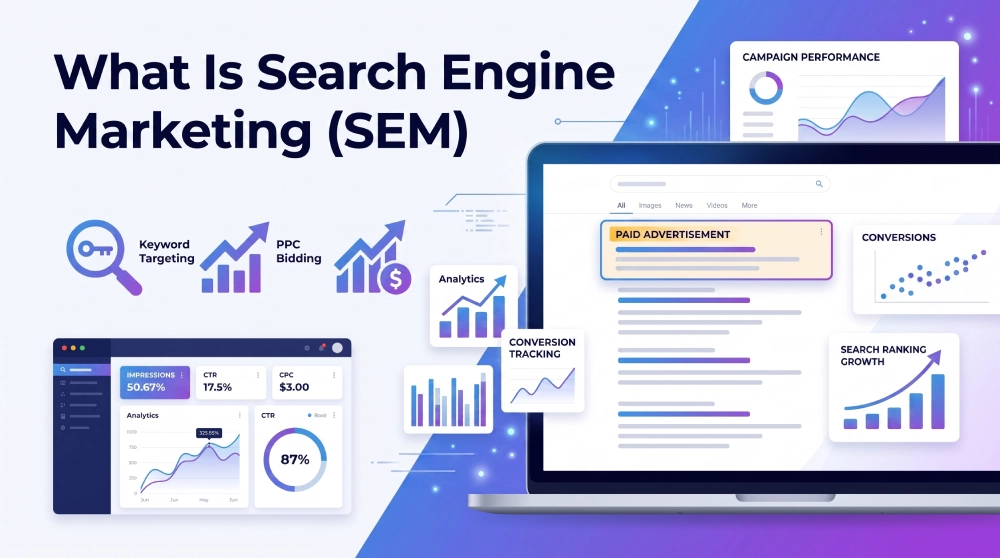
Search engine marketing (SEM) is the practice of increasing the visibility of a website in search engine results pages through paid advertising. SEM’s most common incarnation is pay-per-click (PPC) advertising, including Google Ads and Bing Ads.
SEM allows a business to be at the top of results almost immediately after a campaign has been launched, unlike organic SEO, which relies on unpaid rankings that are developed over time. A quality search engine marketing agency combines keyword targeting, ad copy, and bidding strategy to get the right message in front of the right searcher at the right time. This is also common practice for many companies, using an organic search engine marketing agency approach and using paid ads for quick wins while organic rankings increase in the background.
Importance of Search Engine Marketing for Businesses
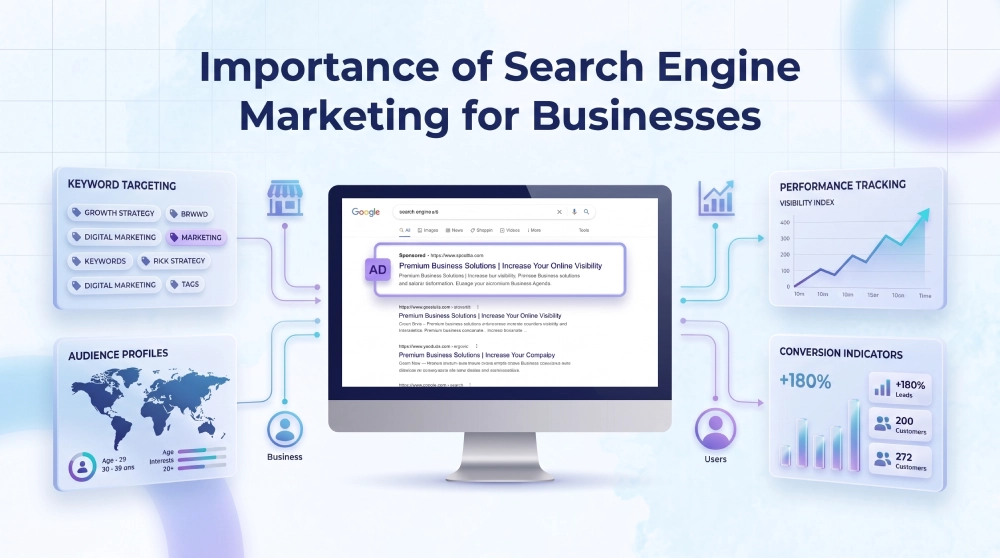
For most businesses, the difference between being found by a customer or a competitor is being on the first page of search results. This is why search engine marketing solutions have become a core part of digital strategy rather than an optional extra. A brand offering managed search engine marketing services can appear instantly for high-intent searches, capturing demand the moment someone starts looking to buy something; organic rankings alone can take months to achieve.
Enterprise organizations face this pressure at an even larger scale. What is enterprise search engine marketing? It refers to SEM programs built for large organizations managing hundreds or thousands of keywords, multiple locations, and complex approval workflows. An enterprise search engine optimization marketing company typically combines paid search with technical SEO, structured data, and cross-channel reporting so that large brands maintain consistency across every market they operate in. For a business of any size, the importance of SEM comes down to one thing: controlling how and when you appear in front of the people already searching for what you sell.
How Search Engine Marketing Works
SEM operates on an auction model. Advertisers bid on keywords relevant to their business and search engines rank the ads based on a combination of the bid amount and the quality of the ad (relevance, expected click-through rate, and landing page experience). And that’s why a low-budget, well-optimized campaign can sometimes beat out a bigger spender with a generic setup.
These are the steps campaigns generally go through:
Audience and keywords research
Ad group and ad copy creation
Alignment, landing page
Your bid strategy
Continuous monitoring and tuning
Each step leads to the next, which is why campaigns that rush through setup seldom perform well over the long haul. Skipping proper keyword grouping, for instance, tends to inflate cost per click later on because ads end up less relevant to the searches triggering them. Search engines reward relevance with lower costs, so the upfront research phase is rarely optional if the goal is sustainable performance rather than a short-term traffic spike. This is also where a dedicated search engine marketing specialist earns their value – catching structural issues before they become expensive habits.
Benefits of Search Engine Marketing
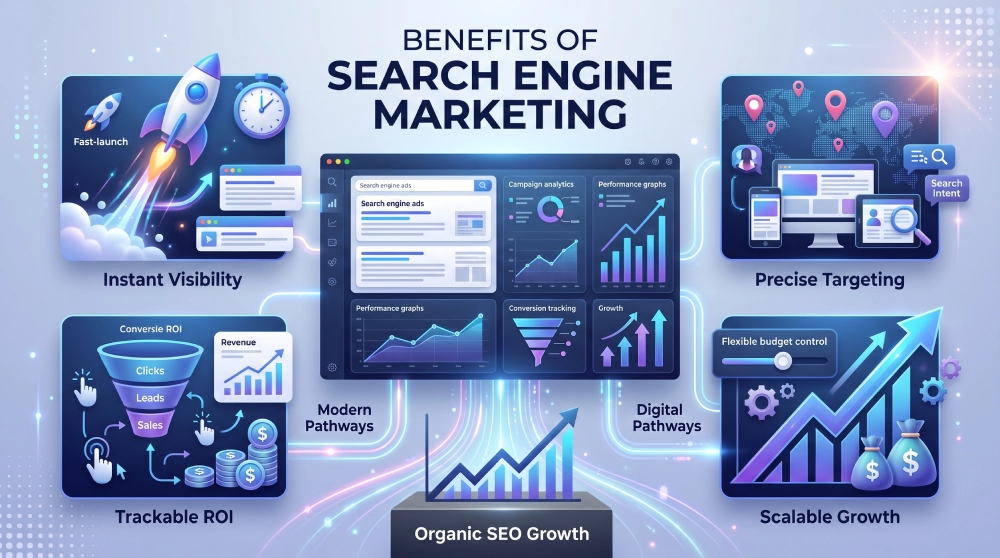
Search engine marketing benefits are much more than just traffic. Done correctly, SEM delivers:
Instant Visibility: campaigns can be up and running, and producing clicks, in hours
Precise targeting: ads are targeted to users based on location, device, search intent, and even time of day.
Trackable ROI: You can track every dollar spent, every conversion, and every click
Scalable growth: budgets can flex up or down depending on performance.
Businesses looking at the benefits of search engine marketing often find it complements long-term SEO rather than competing with it, filling the visibility gap while organic authority is still being built. This is part of why a search engine marketing digital agency will typically advise running the two channels together, not two separate budgets.
Core Components of a Successful Search Engine Marketing Strategy
All high-performing campaigns share the same foundation, no matter the industry:
Component
Component | Purpose |
Keyword research | Identifies what your audience is actually searching for |
Ad copywriting | Converts clicks into qualified leads |
Bid management | Controls cost while maximizing visibility |
Landing pages | Turns traffic into conversions |
Analytics | Measures what's working and what isn't |
Search engine marketing strategy service agencies often begin with a discovery process, auditing current accounts before suggesting structure changes. At this stage, Various analytics and advertising platforms are often used, giving teams a single view of keyword performance, ad spend, and conversion data before building out the strategy.
Keyword Research for Search Engine Marketing
Keyword research moves from guessing to strategy by grouping high-intent terms into tightly themed ad groups. A search engine marketing agency will review this on a monthly basis as search behaviour moves.
Market orientation
Group keywords by theme closely
Target long tail keywords to save money
Review and update negative keywords regularly
Building High-Performing Search Engine Marketing Campaigns
A search engine marketing digital agency builds campaigns on tightly structured ad groups, aligned pages, and constant testing. Managed search engine marketing services catch drift before it wastes spend.
Keep ad groups tightly themed.
Align landing pages to ad copy.
Test continuously, never set and forget
Monitor daily to catch plateaus early
Landing Page Optimisation for Better Campaign Performance
Even great ad copy fails without a matching landing page. An organic search engine marketing agency often applies this same discipline across paid and organic traffic.
Keep load times fast.
Match page message to ad exactly
Use one clear CTA
Add trust signals (reviews, certifications)
Search Engine Marketing Best Practices
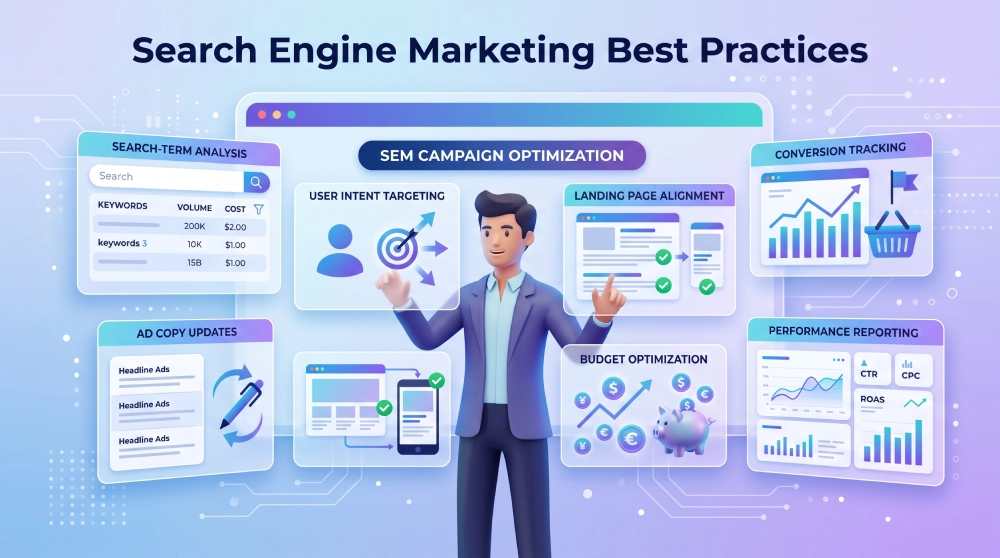
Structure campaigns around user intent, not internal org charts
Refresh ad copy and creative on a regular cycle
Review search-term reports weekly to catch wasted spend
Align landing pages with ad messaging exactly
Set realistic conversion windows before judging performance
Track performance through a consistent reporting suite so historical data stays comparable over time
Common Search Engine Marketing Mistakes to Avoid
Most underperforming campaigns fail for the same handful of reasons, and nearly all of them are avoidable with the right process in place. A search engine marketing specialist can usually spot these issues early, before they turn into months of wasted spend.
Negative keywords not excluded: irrelevant clicks silently consume the budget without ever converting.
Spreading budget too thin: running too many campaigns at once dilutes data and slows optimization.
Treating landing pages as an afterthought: even great ad copy fails if the page doesn’t match the promise.
Skipping the research phase: launching on assumptions instead of real search data almost always costs more than the time it saves
Abandoning campaigns too early: pulling the plug before conversion data accumulates often means quitting right before a campaign was about to stabilize.
Setting a minimum evaluation window upfront and resisting the urge to react to a few slow days is one of the simplest ways to avoid the most costly mistake on this list: quitting too soon.
Factors That Influence Search Engine Marketing Costs
Cost depends on industry competitiveness, keyword volume, geographic targeting, and account maturity. Businesses offering affordable search engine marketing services achieve this through tighter targeting and smaller test budgets rather than cutting corners. Reviewing search engine marketing case studies helps clarify what a given budget actually buys.
Cost Factor | Impact | Typical Range |
Industry competitiveness | Crowded industries cost more | $5–$50+/click |
Keyword volume | More keywords need more budget | $500–$10K+/mo |
Geographic targeting | Broader areas cost more | +10–30% |
Account maturity | New accounts need test spend before scaling | 1–3 months |
Experience That Drives Search Engine Marketing Success
Across the accounts we’ve managed including through platforms like Xperts5 the pattern is consistent: structured campaigns paired with disciplined testing outperform set it and forget it setups every time. Reviewing search engine marketing examples from past campaigns, including budget reallocations that cut cost-per-acquisition significantly, or ad copy tests that lifted click-through rates within weeks, reinforces that iteration, not initial setup, drives long-term performance among top search engine marketing companies. Teams that treat SEM as an ongoing discipline, rather than a one-time launch, consistently see stronger returns over a 12-month horizon than those chasing quick wins.
Future Trends in Search Engine Marketing
AI-driven bid automation, first-party data targeting (as third-party cookies phase out), and the growing overlap between paid search and generative AI search results are reshaping the landscape. Businesses that adapt early, testing new ad formats and audience signals as they roll out, tend to maintain a visibility edge over competitors who are still running legacy campaign structures. Agencies that are ahead of the curve on these shifts, often with the help of dedicated testing and reporting tools, are better positioned to adapt strategy before a change in platform algorithms blindsides their clients.
Final Thoughts
Search engine marketing is still one of the quickest ways to generate qualified traffic if it’s based on good keyword research, disciplined testing, and landing pages that actually convert. Whether you run the campaigns yourself or work with a search engine marketing agency, the basics are the same: know your audience’s intent, align your message to it, and continually optimize based on actual performance data. Businesses that treat SEM as a long-term discipline, not a one-off campaign, are the ones that consistently outperform competitors relying on guesswork alone.
Frequently asked questions
SEM is a type of digital marketing that allows you to pay to be ranked high on search results. A search engine marketing agency’s paid ads generate targeted traffic, qualified leads, and business growth.
Organic ranking is a long game in SEO, whereas SEM provides instant visibility with paid ads. Most businesses do both. They want quick wins now and let organic traffic build in the background. Often, this is done through search engine marketing solutions.
Search engine marketing benefits: Instant exposure, reach your targeted audience, Trackable ROI, Flexible budget, Faster lead generation, More sales by reaching out to people who are already looking for your service.
Cost depends on industry competition, volume of keywords, and how broad your targeting is. Clicks can cost $5 to $50 or more, and small businesses can begin with monthly budgets of $500 to $1,500 and go into the thousands for larger campaigns.
A professional search engine marketing agency takes care of the keyword research, bid strategy, ad creation, and continuous optimisation – the areas most likely to go wrong without experience – so your spend goes to conversions, not guesswork.
It’s SEM on a scale. At multiple locations, brands or markets. Usually, an enterprise search engine optimisation marketing company is employed to prevent campaigns such as this from becoming unmanageable.
Usually the full loop - keyword research, campaign setup, ad copywriting, bid management, landing page optimisation, A/B testing, conversion tracking, and regular performance reporting.
Seek out proven experience, transparent reporting, actual industry expertise and search engine marketing case studies you can verify, not just a heavy sales pitch.
They optimize keywords, test ad copy, tweak bids, tighten landing pages, and monitor the analytics well enough to spot problems before they get costly.
Yes, often larger than the large competitors. Search engine marketing agencies and strategy services allow small businesses to target qualified customers without the need for a big-brand budget.